Article • 4 min read
Digital transformation in public service: A CIO's blueprint for leveraging AI
A practical, people-first approach to AI that helps government agencies modernize services, stretch budgets, and build trust.


Colin Murphy
Chief Customer Officer
최종 업데이트: February 4, 2026


For government agencies, the call to modernize isn’t just about keeping up with technology—it’s about meeting the evolving needs of the communities they serve. As populations shift and digital expectations grow, the public sector faces the unique challenge of delivering a modern, “Amazon-like” experience while navigating tight budgets and legacy systems.
The path forward requires more than just new software; it demands a fundamental shift in mindset. It’s about leveraging technology like AI not just for efficiency, but to foster deeper, more empathetic connections with every resident.
At the 2025 Gartner IT Symposium/Xpo™, we had the privilege of speaking with Anthony McPhearson, the CIO of DuPage County, Illinois. His insights reveal a practical, human-centric blueprint for how public service agencies can successfully embrace digital transformation.
The new reality: A demographic and digital shift
DuPage County, one of the largest counties in Illinois with over 1M residents served, has seen a significant demographic transformation. A post-pandemic influx from urban centers brought in a new generation of residents with different expectations.
“The new generation is really looking for services where they can get access online, almost like Amazon or Netflix,” McPhearson explained. “They would prefer to pay their taxes, submit FOIA requests, and do permitting online… as quickly as possible.”
This creates a complex challenge: how to cater to these digitally savvy residents without leaving behind an older demographic that prefers in-person interactions. For McPhearson, the solution isn’t about choosing one over the other. “Our goal is to meet the needs of all three with limited resources,” he said.
From system-centric to human-centric design
To meet this challenge, DuPage County shifted its approach from being system-centric to human-centric. In the past, technology solutions were built around the system’s capabilities. Today, they are designed around the resident’s needs.
“We are now looking at how I design a solution that helps our residents get access to services quickly and in a confident way,” said McPhearson. This focus on the human experience extends to internal staff, enabling them to better serve the public.
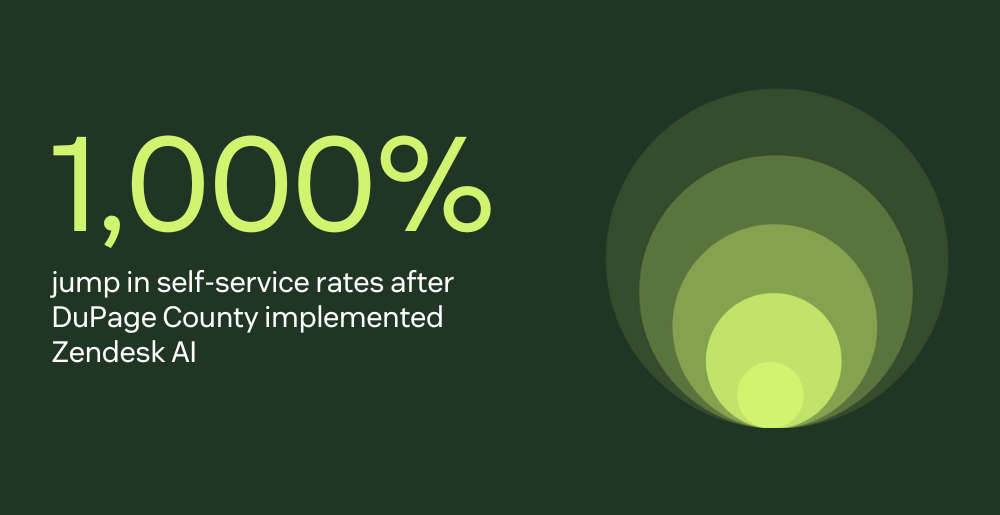
This is where Zendesk’s AI comes in. By implementing Zendesk AI, DuPage County has seen:
- 13% reduction in ticket volumes
- 1000% increase in self-service
- 95% reduction in resolution times
But the most significant impact isn’t just in the numbers:
“The biggest benefit, it allows for my staff to focus on more important things,” McPhearson shared. Instead of spending hours on repetitive tasks, his team now has time to resolve complex problems and engage more meaningfully with residents.
A framework for responsible AI adoption
Adopting AI in government requires a deliberate and cautious approach. To navigate this, DuPage County established a robust governance structure.
Key elements of their framework include:
An AI Task Force: This cross-functional committee includes representatives from IT, legal, HR, and operations to review every AI solution and strategy.
An Impact-Risk Framework: The county uses a framework to evaluate potential AI tools based on their importance to residents, security, compliance, usability, and cost-effectiveness.
A “Slow and Steady” approach: McPhearson advises against rushing into AI. “Take your time,” he urged. “This is not a race. You will have more impact if you’re more strategic.”
Zendesk as a strategic partner
With a lean team of 65 supporting more than 3 thousand users and a million residents, McPhearson emphasizes that his department cannot do it all alone. The key to extending their capabilities lies in cultivating what he calls “strategic partnerships” rather than simple vendor relationships.
“The difference is I have my strategic partners come to the table with solutions,” he explained. “They’re part of my think tank to help me think through better solutions moving forward.”
Lower total cost of ownership to unlock innovation:
Overcoming budget limitations is possible by moving beyond traditional vendor relationships. Forging strategic partnerships with technology providers allows agencies to access cutting-edge solutions, specialized expertise, and innovative service models that would otherwise be out of reach.
Download the digital transformation readiness checklist for public sector IT leaders.
The future of public service is empathetic technology
As government agencies look to the future, the conversation must be about more than just technology. It must be about “digital empathy.” This concept, which McPhearson champions, is about designing AI solutions that are sensitive to human needs. An empathetic AI system knows when to escalate an issue to a live person, whether due to distress, a language barrier, or the complexity of the request. It recognizes that technology is a tool to enhance human connection, not replace it.
For public sector leaders, the journey of digital transformation is an opportunity to reimagine how services are delivered. By putting people at the center, building strong partnerships, and adopting technology with intention and empathy, government agencies can build a more efficient, accessible, and responsive future.