Article • 5 min read
Designing better resolutions through a Jobs to Be Done mindset
Aligning people, processes, and technology around actual customer goals.


Selina Tedesco
Senior Customer Insights Manager at Zendesk
최종 업데이트: December 8, 2025


I recently had an issue with a new couch I purchased — it was leaking feathers, and I was finding them everywhere in my house.
Naturally, I went to the manufacturer’s website to figure out what to do. But after twenty minutes of clicking through product pages and FAQs I couldn’t find a single place to understand my warranty or get replacement cushions. Eventually, I gave up and reached out to customer service.
A few minutes into the chat, as I waited for the agent to pull up the right information, the agent messaged me: “How’s your day going today?”
I smiled — as someone who talks about customer experience every day, both at Zendesk and when I teach college students, I recognized the effort to create a personal, friendly interaction. But as a customer, I wasn’t in the mood for small talk. What I really wanted was a clear answer and a fix for my very fluffy living room.
Yet even after searching the website, calling customer service, and waiting days for an automated email telling me I had no options, my ticket was closed but my issue was never resolved.
What’s interesting is that, on paper, my entire experience would be marked as a success: I viewed a help center article, received a warm, personalized interaction from an agent, and my ticket was officially closed — but it was all without ever getting a real resolution.
As customers, we do appreciate friendliness, helpful FAQs, and having accessible channels when we need support. But in moments of real need, what we value most is how these capabilities come together to deliver clarity, progress, and confidence that our needs are being taken care of.
When I teach experience design to my students, we often talk about the connected touchpoints that make up the services and experiences we use every day. In a well-designed end-to-end journey, every moment should have intention and meaning — each interaction should move the customer closer to what they need.
But while that sounds straightforward, in reality complexity often wins out. Internal processes, legacy systems, and organizational silos can easily overshadow the user. And that’s when we all end up in those familiar moments of frustration: clicking in circles on a website, being transferred between departments, or receiving “helpful” updates that don’t help at all.
This is where a Jobs to Be Done mindset becomes powerful. It helps us strip away the noise and focus our CX strategy on the one thing customers actually care about: making real progress toward a meaningful resolution.
Understanding the job behind the request
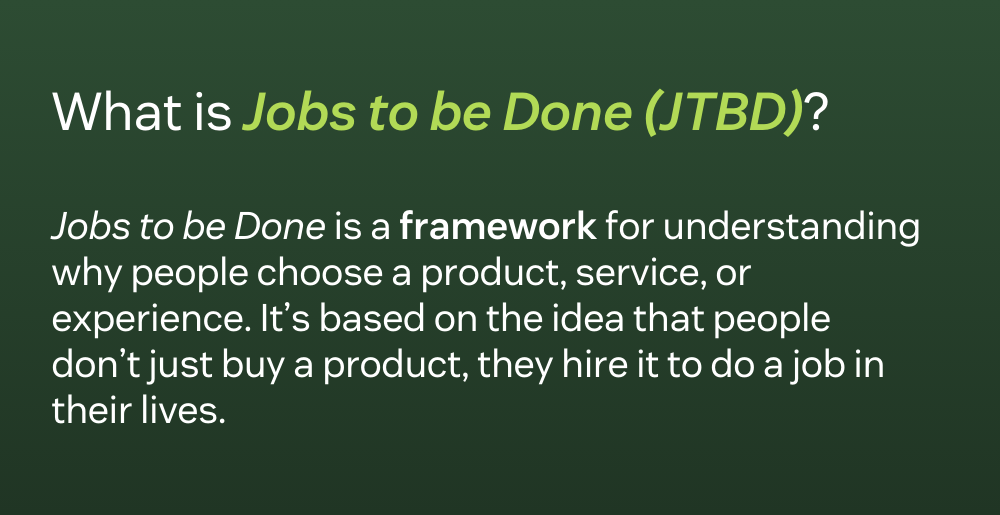
Jobs to Be Done, often shortened to JTBD, is a framework for understanding why people choose a product, service, or experience. It’s based on the idea that people don’t just buy a product, they hire it to do a job in their lives.
When I incorporate JTBD in my classes, I ask students to think less about what a product is and more about what it helps someone accomplish. A couch isn’t just furniture — it’s hired to create comfort, host friends, or offer a place to unwind at the end of the day. It’s a similar idea to the classic sales prompt, “Sell me this pen,” where the goal isn’t to describe the pen but to understand what the person needs it for: to sign an important contract, to capture an idea quickly, to feel prepared. This shift helps students see experiences as chains of progress, not isolated touchpoints.
When applied to customer experience, JTBD helps us see what customers are really trying to accomplish beneath the surface of a support request.
In my case, I wasn’t just trying to fix a couch. I wanted to feel confident that my purchase was sound, to understand what went wrong, and to know that the company stood behind its product. Those were the real “jobs” I was hiring customer support to do, and none of them were completed that day.Every support interaction carries two dimensions:
- The functional job: what the customer needs to get done.
- The emotional job: how they want to feel once it’s resolved.
Both matter. And when one is missing, the experience feels incomplete.
Designing for true resolutions
Many customer experience processes are built for efficiency: routing tickets, tracking SLAs, reducing handle time. While important, they don’t always translate to progress for the customer.
A Jobs to Be Done mindset shifts the focus toward outcomes. It helps teams design experiences around what customers are truly trying to accomplish and how they define success.
That might look like:
Using automation to help customers solve problems faster, not push them away.
Giving agents the context and flexibility to adapt based on the customer’s goal.
Updating policies to remove hidden barriers that slow customers down.
Measuring whether customers leave the interaction feeling informed and confident.
When teams align around these outcomes, resolution becomes a way to reinforce trust and strengthen the relationship.
Recentering on what matters
Revisiting Jobs to Be Done in the context of customer experience helps us remember what great experience design has always required: understanding the needs of our users, reducing effort, and helping people make progress when they need it most.
Today, AI offers an expanded toolkit to deliver on that promise. Teams can understand intent at scale, automate the repetitive steps that slow customers down, and surface answers exactly when and where they’re needed. It opens up possibilities we’re only beginning to imagine and gives CX teams new ways to build journeys that are efficient and aligned with the real jobs customers are trying to accomplish.
AI and service design are converging in a way that invites us to rethink what resolution means. Instead of viewing it as the final step in closing a ticket, it becomes the moment where technology and human support work together to help customers genuinely move forward. Designing with this perspective shifts resolution from a metric to an outcome customers can feel. It gives teams a clearer path to delivering support that’s faster, more intuitive, and built around meaningful customer relationships.


